

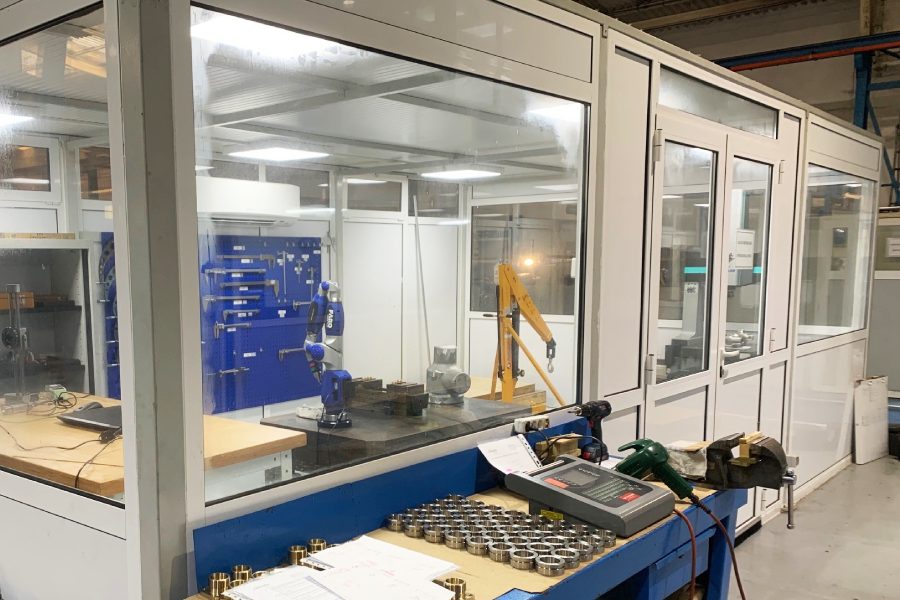
In the metrology room, meeting the tightest tolerances required by an OEM becomes the key difference between a part that “looks right” and a “part accepted” a process that is only possible under controlled measurement conditions and with traceable evidence. In the manufacturing and verification of critical components (bodies, covers, shafts, impellers, etc.), it is not just about “measuring,” but about ensuring that every measurement is repeatable, auditable, and useful for decision-making. This capability is especially important in the machining of industrial valve bodies, where the validation of gasket faces, seat housings, functional diameters, and other critical areas directly affects sealing performance, internal alignment, and final acceptance by the customer.
In this article, with an industrial approach, you will see what a climate-controlled metrology room delivers, how a metrological traceability chain is built, which equipment is used (including 3D CMM measurement), and how the results connect to machining, welding, and customer acceptance.
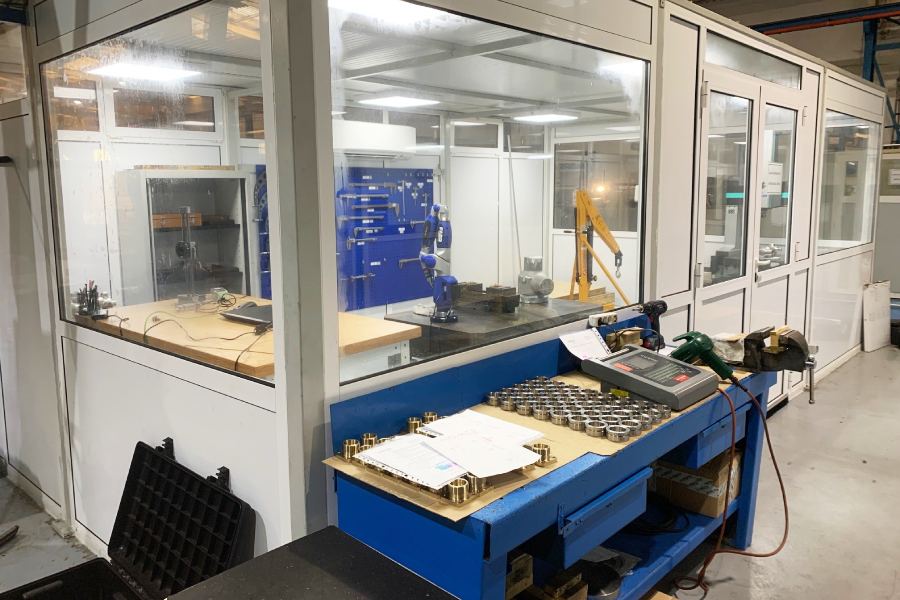
The air conditioning system must also meet the accuracy requirements, especially for three-dimensional measuring machines (CMM).
Why a metrology room changes the outcome of a project
Well-planned metrology and quality inspection reduces rework, prevents incoming inspection rejections, and removes uncertainty at critical stages such as assembly, hydrostatic testing, leak-tightness checks, or dimensional validations.
In practice, a metrology room with quality control provides three direct advantages:
- It reduces measurement variability (temperature, humidity, vibrations, handling).
- It makes it possible to justify tolerances and complex geometries using a standard criterion.
- It provides documentary support when the customer requests evidence: reports, records, calibrations.
That is why, when we talk about industrial metrology with quality control, the goal is not to “have nice-looking instruments,” but to control risk: risk of rejection, risk of failure on the test bench, risk of problems in service.
Environmental conditions: The “why” behind 20°C and thermal stability
In industrial metrology, one basic principle applies: materials expand and contract. That is why 20°C is commonly used as the reference for geometric specifications and dimensional verification. If you measure outside controlled conditions, the reading can be “correct” and still fail to represent the dimensional reality required by the drawing.
In an industrial environment, the metrology room must minimize:
- thermal gradients (spatial variations within the room),
- time-based variations (peaks throughout the day),
- external influences (drafts, vibrations, direct exposure to heat sources).
This becomes especially important when you move from quick checks to critical inspections such as the dimensional inspection of machined parts, or verifications of concentricity, coaxiality, flatness, and complex geometries.
Metrological traceability chain
In metrology, traceability is the ability to relate a measurement result to national or international standards through an unbroken chain of comparisons. This chain is fundamental to metrological traceability and calibration, and it is what makes a measurement “defensible” in the context of audits.
What makes traceability robust in an industrial environment
For traceability to be real (and not just a nice concept), you need:
- A documented and repeatable procedure (how to measure and how to record results).
- Identified instruments (range, serial number, status).
- Defined calibration intervals aligned with criticality.
- Calculation and criteria for measurement uncertainty in industrial metrology.
- Evidence (certificates, labels, internal records).
This becomes “real” when it leads to out-of-tolerance parts, incoming rejections, or assembly deviations. For practical examples and a prevention approach, see dimensional measurement errors: causes, impact, and how to prevent them in machined components.
From an OEM perspective, the question is not “Do you have a metrology room?”, but:
Can you prove that the measurement is reliable and comparable over time?
ISO 17025: When it matters and how it’s interpreted in practice
In many sectors, customers require calibration and measurement management to follow criteria aligned with accredited laboratories or recognized standards. That is why it is relevant to introduce the concept of ISO 17025 calibration for measuring instruments not as bureaucracy, but as a guarantee of competence, method, and consistency.
This ties directly to metrological inspection requirements: the customer defines what they need to see, which tolerances apply, which points are critical, how often to measure, and what documentary evidence must be provided.
Metrology laboratory equipment at Asimer Group
A well-equipped room is not just “having a caliper.” We are talking about metrology laboratory equipment designed to cover everything from quick checks to complex, traceable verifications.
At Asimer Group, the approach is industrial: selecting the instrument and the method based on criticality, tolerance, and the component’s function. That is why it makes sense to talk about:
- industrial metrology equipment for dimensional verification of critical components,
- metrology laboratory equipment in a controlled environment,
- methods for complete geometric and dimensional inspections.
Measurement range
The range defines the interval of values an instrument can measure. A wider range adds versatility, but it can reduce resolution (depending on the equipment). In industrial inspection, range is not chosen “from a catalog” it is chosen based on the part: a shaft is not measured the same way as a housing, and a large dimension is not controlled the same way as a fit tolerance.
Resolution
Resolution is the smallest detectable change. With tight tolerances, resolution becomes critical: if your instrument cannot resolve the dimension, the measurement loses its value. That is why using the right method matters and, when applicable, relying on advanced systems such as 3D CMM measurement (when geometry requires it and the customer requests it) makes sense.
Calibration
Calibration compares the value measured by a standard with the instrument’s reading using a method that ensures traceability. This supports the entire documentary chain and is the foundation for maintaining an acceptance criterion.
Dimensional inspection of complex industrial parts
To inspect industrial components with complex geometries (including alignments, profiles, roundness, shapes, and positioning), highly flexible measurement solutions are required. These tools are essential to capture the full geometry of the part without compromising dimensional control.
In industrial metrology practice, this involves using specific instruments such as:
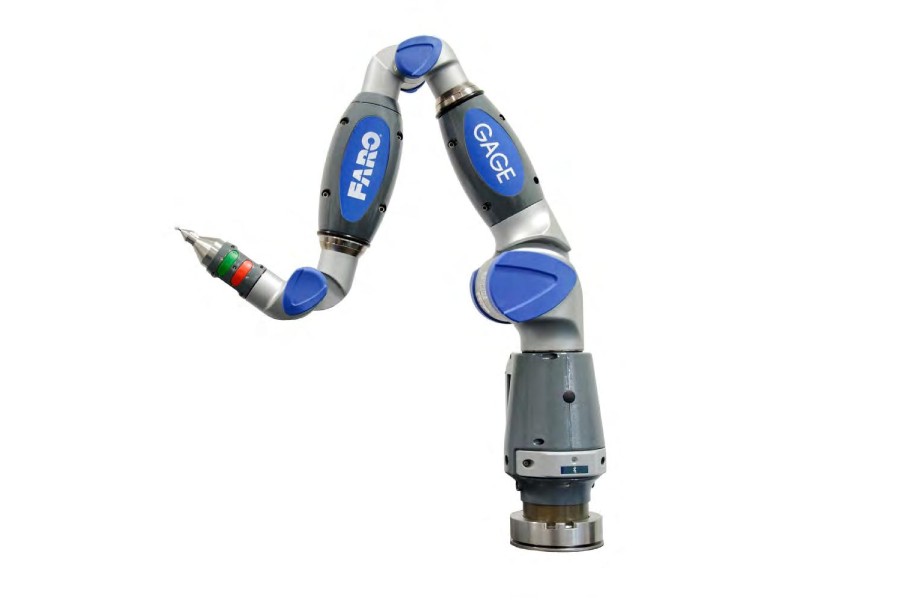
- Measuring arm / articulated arm: Ideal for verifying complex geometries, alignments, and measuring critical points and form requirements.
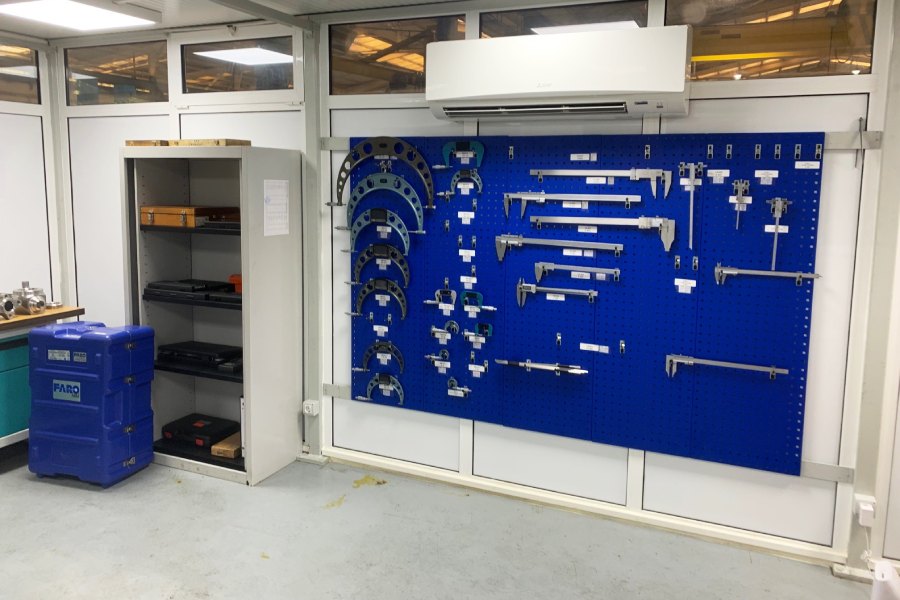
- Measuring and Testing Instruments (IMEs): They form the basis of dimensional control to ensure repeatable measurements.
The measuring arm is a key resource for addressing geometric complexity, which justifies linking to specific materials about its usefulness and application in this context.
Measurement and process: Why measuring alone isn’t enough
In industrial metrology, dimensional data only adds value if the process is capable of reproducing it. When machining is not stable, variations appear in diameters, coaxialities, or flatness, and these are then “chased” through measurement and rework. That is why there is a direct relationship between dimensional control and process stability: we cover this in accuracy in CNC machining. And if you need context on how geometry is generated (and where typical deviations occur), the framework of machining by chip removal helps explain why certain dimensions require reinforced verification.
This is fundamental, because it explains why many companies prioritize (and evaluate suppliers based on) criteria such as:
- CNC-machined part dimensional verification.
- Metrology services applied to CNC machining.
- And, crucially, the ability to provide repeatable dimensional control for machined parts.
Dimensional report and traceability: The key in OEM supplier evaluation
In industrial and qualification projects, the value of measurement does not lie only in the dimensional reading, but in the documented report that supports it. This final document is the acceptance evidence required by the customer (OEM), making it a critical part of the deliverable. An industrial metrology room is essential to generate this evidence, which is built on traceability.
When an industrial buyer or a quality team evaluates a supplier, the focus is on documentary capability and technical rigor. The key questions that define qualification are:
- Can you deliver a dimensional report that meets our OEM requirements?
- What traceability does the measurement have (i.e., how is it linked to recognized standards)?
- What do you do when a dimension is at the limit of tolerance?
- Do you have the capability to repeat the measurement under the same criteria and controlled environmental conditions?
Being able to answer these questions convincingly turns the metrology room into a real value and differentiating argument not just an asset.
Industrial metrology applied to pumps and valves
When metrology is applied to functional components such as pumps and valves, measurement becomes even more critical. These elements include seating surfaces, sealing areas, fits, concentricity, coaxiality, and geometries that directly affect performance. For this reason, a rigorous approach to dimensional control of valves and dimensional verification of pumps is essential.
For a complete understanding, it can be useful to consult the functional framework of industrial pumps, as well as to understand the relationship between a valve and testing and leak-tightness requirements to prevent leaks and validate the design.
Metrology + inspection: How it complements NDT and quality
A dimensional measurement can tell you “the geometry,” but it does not tell you “the material integrity.” In many projects, the robust approach is to combine dimensional control with quality inspections that detect discontinuities without affecting the part.
For this purpose, inspection is supported by essential disciplines such as:
- Non-destructive testing (NDT)
- Types of non-destructive testing
- Penetrant testing (liquid penetrants)
- NDT certification for industrial quality
The logic is simple: combining geometry + material reduces the component’s overall riskespecially when there are welds, overlays, repairs, or severe service requirements.
The metrology room at Asimer Group: A key system for quality
The metrology room should not be understood simply as a physical space, but as an integrated system designed to ensure maximum measurement accuracy. This system is built on several essential pillars:
- Environmental stability: rigorous control of ambient conditions to avoid variations that affect measurement.
- Measurement method: application of standardized and validated procedures.
- Documentary traceability: maintaining a complete, verifiable record of the entire measurement process.
- Responsiveness: agility to detect and manage deviations or non-conformities.
This systematic approach aligns directly with the vision of industrial digitalization and Industry 4.0, and integrates key technologies such as:
- CNC technology and CNC machining.
In addition, measurement consistency and reliability become critically important, especially in projects involving:
- Machining of large-dimension valves or highly complex components.
Metrology goes beyond simply “improving quality.” Its application has a direct impact on reducing the cost of poor quality by decreasing uncertainty in processes.
Metrology goes beyond simply “improving quality.” Its application has a direct impact on reducing the cost of poor quality by decreasing uncertainty in processes.
Quantitative impact of metrology: Beyond quality
Metrology goes beyond simply “improving quality.” Its application has a direct impact on reducing the cost of poor quality by decreasing uncertainty in processes.
Quantifiable benefits of reducing uncertainty:
- Reduced need for rework.
- Fewer rejected parts.
- Minimization of production stoppages and repeat testing.
- Shorter adjustment and optimization cycles.
Connection to key industrial objectives:
- Economic efficiency: Costs can be optimized in the manufacturing and machining of critical components such as pumps and valves.
- Sustainability and environmental footprint: By reducing waste (less rework, fewer rejections), energy consumption, scrapped material, and non-productive time are reduced directly contributing to lowering the carbon footprint of industrial pumps and valves.
Frequently asked questions
What is the difference between a metrology room and measuring on the shop floor?
The metrology room reduces variables (temperature, humidity, vibrations) and improves repeatability. This makes measurements comparable over time and defensible during an audit.
When do I need a CMM or 3D measurement?
When there are complex geometries, demanding geometric requirements, or when the customer requires a full report. In those cases, 3D CMM measurement enables verification and documentation with greater consistency.
What does metrological traceability mean?
That every measurement can be linked to recognized standards through a chain of calibration and records, ensuring the data has real technical value.
What should I ask a supplier for if I need OEM acceptance?
That they can deliver an OEM-compliant dimensional report, calibration evidence, equipment identification, an uncertainty criterion, and piece/lot traceability where applicable.
Is metrology also useful when there is welding or overlays?
Yes. In fact, it is critical because welds and overlays can introduce distortions, residual stresses, and geometry changes that must be verified to ensure dimensional compliance and functional performance.
“`htmlDo you need support with dimensional measurement and inspection?
Tell us which components you need to control (bodies, covers, shafts, impellers, trims), what tolerances the OEM requires, and what documentation you need (dimensional reports, calibrations, inspections). We’ll respond with a technical approach, not a sales pitch.
Request a metrology & dimensional control assessment