
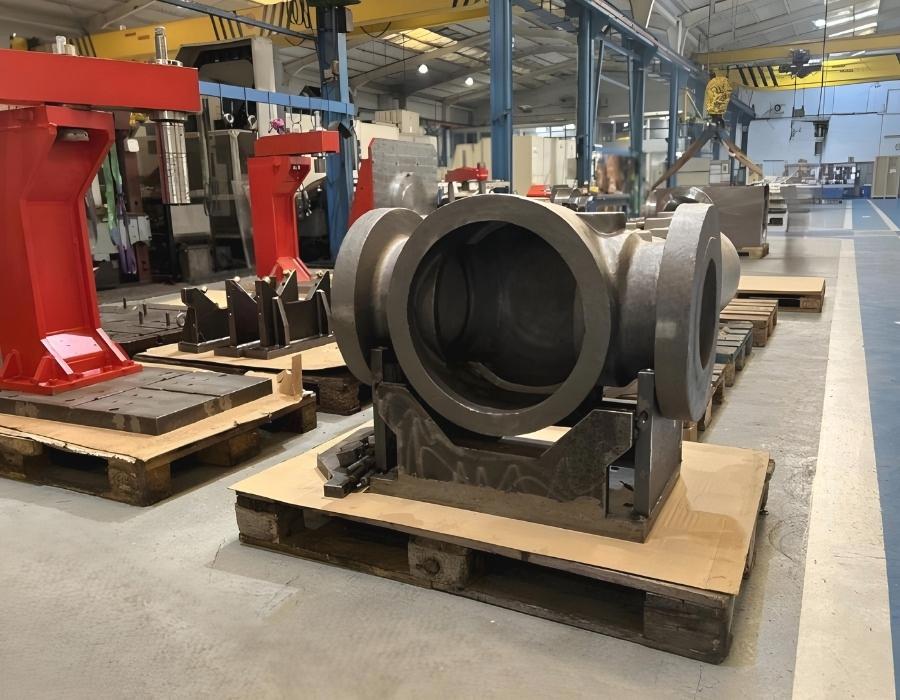
The machining of large-dimension valves is one of the most demanding jobs in industrial environments because it does not simply involve working with heavy or bulky parts, but ensuring that every functional surface maintains the geometry required for the valve to operate safely, accurately, and consistently. When a large valve fails, it rarely fails because of its size alone. It fails because a critical area has not been machined to the level of accuracy required by the application: a gasket face, a housing, a functional diameter, or a geometric reference that determines tightness, alignment, or in-service performance.
In sectors such as oil & gas, petrochemicals, chemical processing, energy, naval, or water treatment, even the smallest deviation can lead to leakage, poor shut-off, loss of performance, or costly downtime. That is why machining large valves cannot be approached as a simple heavy manufacturing process. It requires technical judgment, machine capability, control over critical features, and experience in working with tight tolerances on complex components.
At Asimer Group, we approach this type of project with a results-driven mindset. We analyze the drawing or sample, define the machining references, assess the functional surfaces, and work with the goal of ensuring in-service reliability, dimensional control, and precision in the areas that truly determine valve performance. This is the approach that makes it possible to turn a complex project into a machined solution with full guarantees.
What machining large-dimension valves requires in demanding industrial sectors
Machining large-dimension valves requires a different technical strategy from that of a conventional valve. As size, weight, and geometric complexity increase, so do the risks of deformation, misalignment, and cumulative error. A large-format valve not only requires more material to be machined, but also a process logic that preserves the relationship between critical surfaces, reference centers, and functional areas.
In a component of this kind, meeting isolated dimensions is not enough. It is essential to ensure the geometric relationship between gasket faces, seat housings, support surfaces, internal diameters, and connection areas. If these areas are not machined consistently, the valve may suffer from leakage, defective shut-off, assembly difficulties, or unstable behavior under high pressure.
In addition, machining a large valve is often influenced by other factors: material type, internal stresses in the part, the need for pre-machining operations, the risk of distortion during clamping, accessibility to functional areas, and final dimensional inspection requirements. For that reason, the process must be planned from the outset with a clear strategy for references, operation sequence, and validation of every critical surface.
When a company is looking for a supplier for this type of work, it should not focus only on machine capacity. It should also assess whether that partner can manage, with sound technical judgment, everything that affects the actual accuracy of the component. That is where the combination of experience, resources, and control becomes valuable. And that is also where the difference between generic machining and a well-executed project becomes clear.
Do you need support for machining large-dimension valves for critical applications?
Tell us the valve type, material, nominal diameter, service conditions, and inspection requirements. We analyse your project and define a technical machining approach focused on precision in critical areas, sealing reliability, and dimensional control.
Request technical assessmentCritical areas in large-dimension valves that determine tightness and reliability
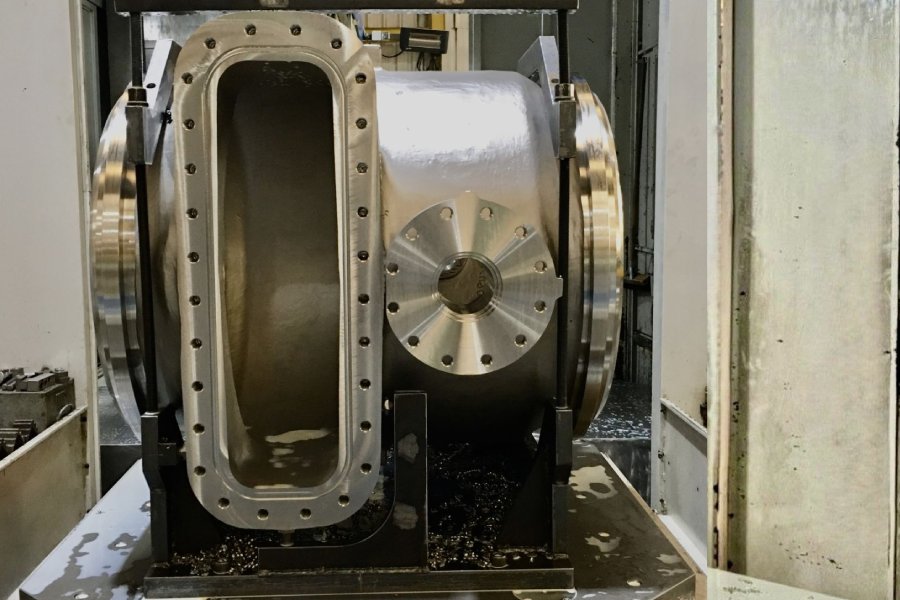
In the machining of industrial valve bodies, the real challenge is not machining the entire part, but getting it right where it matters most. Large valves include several surfaces whose geometric quality directly affects shut-off capability, assembly stability, and the component’s performance once installed in service.
Gasket faces are among the most sensitive areas, because their flatness, surface finish, and correct relationship with the rest of the body largely determine the tightness of the system. Seat housings, functional diameters, centering surfaces, and alignment references are equally critical. When any of these areas show deviations, assembly becomes more difficult, shut-off may be compromised, and the whole unit begins to operate outside the expected conditions.
This must be combined with strict control of alignment and concentricity, especially in large parts where the weight of the component itself, the clamping setup, or the machining sequence can introduce distortion or misalignment. A large industrial valve is not validated by a single measurement. It is validated by the relationship between all the surfaces that determine its behavior.
That is why, at Asimer Group, we approach this work with a focus on critical areas and the functional geometry of the part. It is not just about “shaping” the component, but about ensuring that every operation helps preserve the correct relationship between surfaces and reduces the risk of future failure. This approach is essential when talking about machining valves with critical tolerances, and it becomes even clearer when exploring topics such as critical tolerances in industrial valve bodies, where these functional areas are analyzed in greater detail.
Technical challenges in machining large-dimension valves
One of the main challenges in machining large-dimension industrial valves is handling heavy components without compromising final accuracy. A heavy part, with complex geometry or uneven material distribution, may respond differently to clamping, support, or tool feed. If this stage is not properly controlled, the subsequent machining process carries over errors that ultimately affect the component’s functionality.
Another major challenge is the material itself. Many valves are made from stainless steels, corrosion-resistant alloys, or other materials designed to withstand severe operating conditions. These materials require an appropriate cutting strategy, thermal control, the right tooling, and a sequence of operations that minimizes internal stresses and preserves surface quality. When the project also requires specific corrosion resistance or compatibility with particularly aggressive process conditions, it is worth looking more closely at cases such as machining pumps and valves in stainless steel or machining valves in duplex and super duplex, where the behavior of the material directly shapes the process.
This is combined with the need to machine internal and external functional surfaces with precision on parts that may include difficult geometries, deep areas, or complex access paths for tools and fixtures. That is why machining industrial valve components cannot be approached with an oversimplified mindset. It requires planning, experience, and real technical capability.
In this context, the choice of process and equipment is no longer a secondary detail. The combination of chip-removal machining, proper tool selection, and process control is essential to prevent deviations, overheating, or inconsistent finishes. In the same way, having the right CNC machining tools and a methodology based on precision in CNC machining makes it possible to work more reliably on critical surfaces where there is no margin for error.
Asimer Group’s capabilities for machining of large-dimension valves
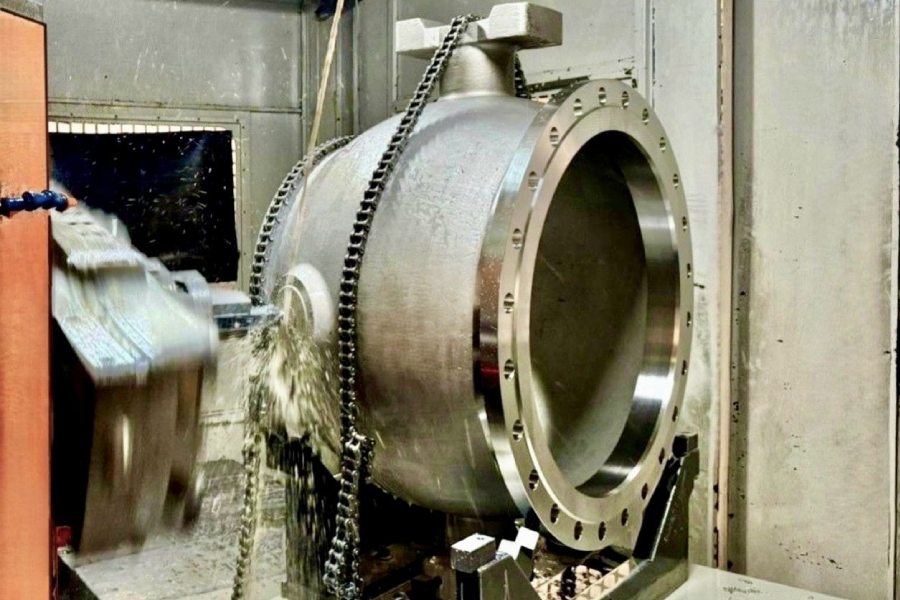
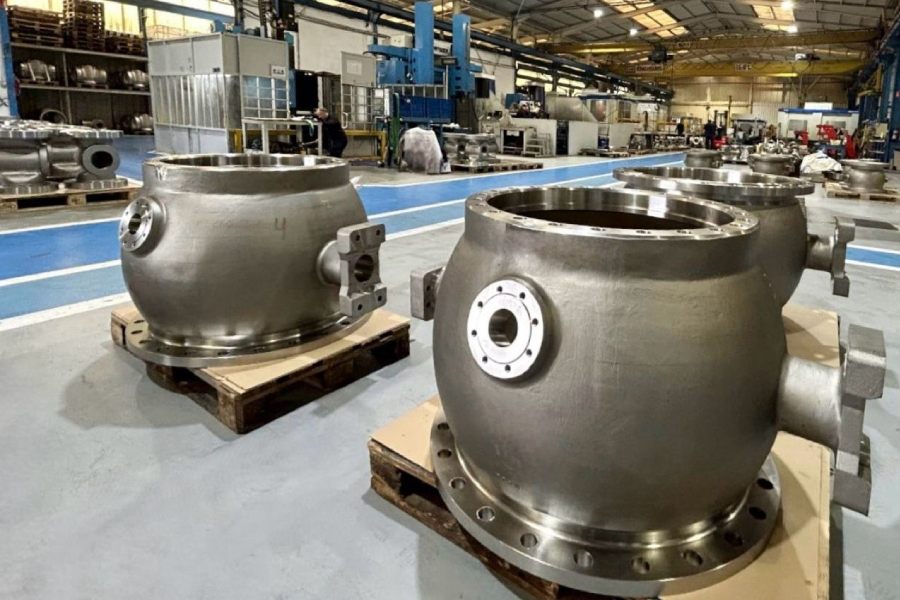
At Asimer Group, we machine large-dimension valves using resources prepared for complex, high-value technical components. Our capability combines specialized machinery, advanced programming, and experience in machining critical geometries where precision is non-negotiable.
For this type of project, vertical lathes, boring mills, and CNC machining centers are essential, because they make it possible to work on external surfaces, internal areas, and functional zones with a high level of control. In large-format valves, this type of equipment does not only provide capacity; it also provides repeatability, accessibility, and stability when machining complex geometries under demanding tolerances.
We also work from drawings or samples, adapting the machining strategy to the component, the material, and the service conditions it must withstand. This approach is especially important when discussing precision machining for large valves, since not all valves require the same sequence of operations, the same reference points, or the same verification criteria.
From a process standpoint, the use of advanced programming and CAD/CAM solutions helps anticipate difficulties, optimize sequences, and reduce the margin for error. But what truly supports the final result is the combination of machinery, experience, and control over the functional geometry of the part. This technical capability becomes even clearer when analyzing the value provided by a Trevisan machining center, the real impact of CNC technology on complex parts, or the role of CNC machining when the priority is not only production, but also maintaining geometric stability and repeatability in functional areas.
Dimensional control and quality in large industrial valves
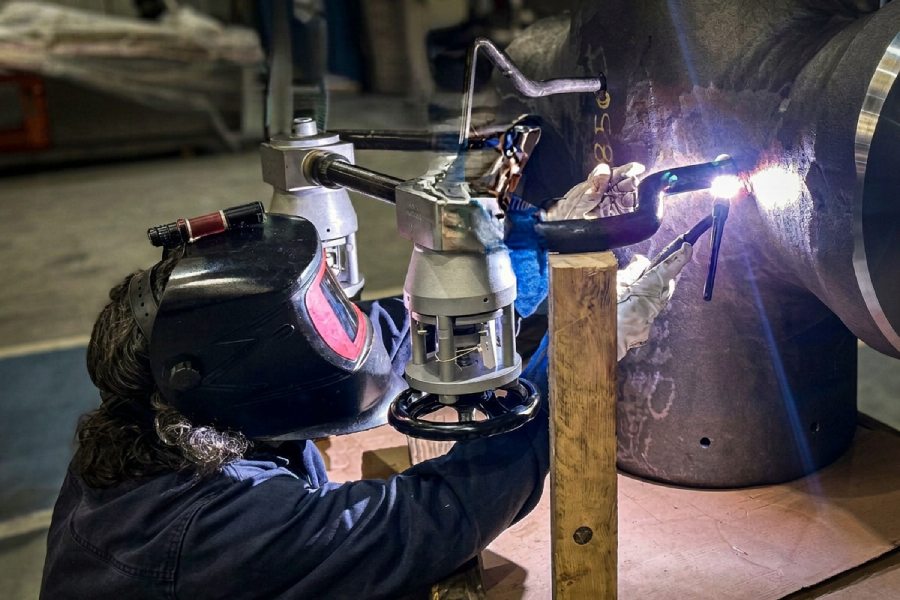
In the machining of valves for high-pressure applications or environments where reliability is critical, quality control cannot be limited to a superficial inspection. It is essential to verify that the functional surfaces maintain the geometry, alignment, and tolerances required to perform correctly under demanding conditions.
Metrology and dimensional inspection make it possible to confirm that gasket faces, functional diameters, seat housings, and geometric references comply with the project specifications. This is not only useful for “closing out” the job, but also for ensuring that the valve does not carry cumulative deviations that may later appear during assembly or in service.
In addition, traceability becomes especially important in large components. Being able to link operations, inspections, and validations to the critical areas of the component increases confidence, reduces uncertainty, and makes the technical reading of the project easier. This is further supported by the option to apply non-destructive testing when the part or specification requires it, with the aim of confirming the integrity of the component without compromising it.
At Asimer Group, we strengthen this phase with measurement and control resources adapted to the size and criticality of the part. Our metrology room allows us to rigorously validate the most sensitive functional surfaces, while the measuring arm and different measuring instruments help verify geometries, alignments, and references on large-format components. When the project requires it, this work is complemented by non-destructive testing and specific inspections such as liquid penetrant testing, further reinforcing the final reliability of the component before delivery.
Industrial applications where machining of large-dimension valves is critical
Large-format industrial valves are used in sectors where operating conditions are severe and the margin for error is minimal. They are commonly found in oil & gas, petrochemicals, chemical processing, energy, marine, and water treatment, where the precision of the component directly affects safety, fluid control, and system continuity.
In these environments, machining valves for the chemical industry or for highly demanding processes does not depend only on the final dimension. It also depends on material behavior, surface quality, the correct relationship between functional areas, and the valve’s ability to maintain tightness and dimensional stability under pressure, corrosion, or temperature.
When a valve is intended to operate in corrosive environments, under severe cycles, or with high reliability requirements, the level of control required during machining is far greater. The same applies in high-pressure systems, where a deviation in a shut-off or coupling area can have serious operational consequences.
That is why machining valves for demanding environments must be approached as a critical operation on critical components, not as just another stage in the manufacturing process. This becomes even clearer when looking at the importance of sectors such as oil refining, applications involving cryogenic valves, or systems where flow control valves must operate accurately under complex and changing conditions.
How to choose a partner for machining large-dimension valves
If you are considering outsourcing the machining of large-dimension valves, you are most likely not only concerned with who can machine the part, but with who can do it without compromising tightness, alignment, or the final functionality of the assembly. In this type of project, the real risk usually does not lie in “manufacturing” the part, but in machining a critical area incorrectly and discovering the problem too late, when the valve has already been assembled, inspected, or even put into service.
That is why, before choosing a supplier, it is worth asking very specific questions. Do they have the real capability to handle the size, weight, and geometry of your valve? Can they control gasket faces, housings, functional diameters, and alignment references with sound technical judgment? Do they have the right dimensional verification resources for large-format components? Do they understand which tolerances are truly functional and which ones directly affect the reliability of the component?
If the supplier only conveys machine capacity, but does not talk about reference points, machining sequence, dimensional control, and validation of critical surfaces, they are probably not approaching the project as they should. In large industrial valves, a poor decision at this stage can lead to deviations, rework, delays, and extra costs that ultimately affect both the timeline and the overall performance of the project.
Choosing the right partner is not just about finding someone willing to take on the part. It is about finding a team capable of technically interpreting the component, anticipating risk points, and planning a machining process that protects what really matters: functional geometry, in-service reliability, and the final behavior of the valve. In that sense, working with an approach focused on reducing errors and rework also has a direct impact on project profitability, just as it does when the goal is to optimize costs in the machining of pumps and valves.
Asimer Group as a partner for machining large-dimension valves
At Asimer Group, we take part in large-dimension valve machining projects with an approach focused on the actual precision of the component, not just on carrying out a machine operation. Our work is centered on protecting the functional geometry of the valve, controlling critical surfaces, and ensuring that each part reaches its final stage with the dimensional quality required by its operating environment.
The combination of machining capability, metrological control, and experience with complex parts allows us to take on projects where precision and reliability are non-negotiable. This way of working is especially valuable when the valve is intended to operate in demanding sectors, with resistant materials, tight tolerances, and high service requirements.
When a project also requires a specific specialization based on material or operating conditions, that experience can be reinforced by more focused content from Asimer’s own technical environment. This is the case with machining pumps and valves in stainless steel, machining valves in duplex and super duplex, or critical tolerances in industrial valve bodies, all of which help explain how machining requirements change when more demanding materials, corrosive environments, or especially sensitive functional surfaces are involved.
If you are looking for a partner for machining large-dimension valves with real capability, technical control, and a focus on critical functional areas, Asimer Group can help you assess your project from a perspective of precision, reliability, and industrial feasibility.
Frequently asked questions about machining large-dimension valves
Which areas are the most critical to ensure tightness in a large valve?
The most sensitive areas are usually gasket faces, seat housings, functional diameters, and support surfaces that must maintain alignment and stable geometry in relation to the rest of the assembly.
Which tolerances are critical in machining large industrial valves?
They depend on the design and application, but they are usually concentrated in shut-off areas, centering features, geometric reference points, and fits between components that directly affect tightness and in-service reliability.
Which materials can Asimer Group machine for large-dimension valves?
We can work with materials commonly used in demanding industrial environments, including stainless steels and other resistant alloys, always depending on the part, its geometry, and the project requirements.
What equipment is used to machine large-format valves accurately?
Depending on the part, vertical lathes, boring mills, CNC machining centers, and dimensional verification resources adapted to the size and criticality of the valve are used.
Which sectors most often require the machining of large-dimension valves?
Mainly oil & gas, petrochemicals, chemical processing, marine, energy, and water treatment, where flow control requires reliable components under conditions of pressure, corrosion, and wear.