
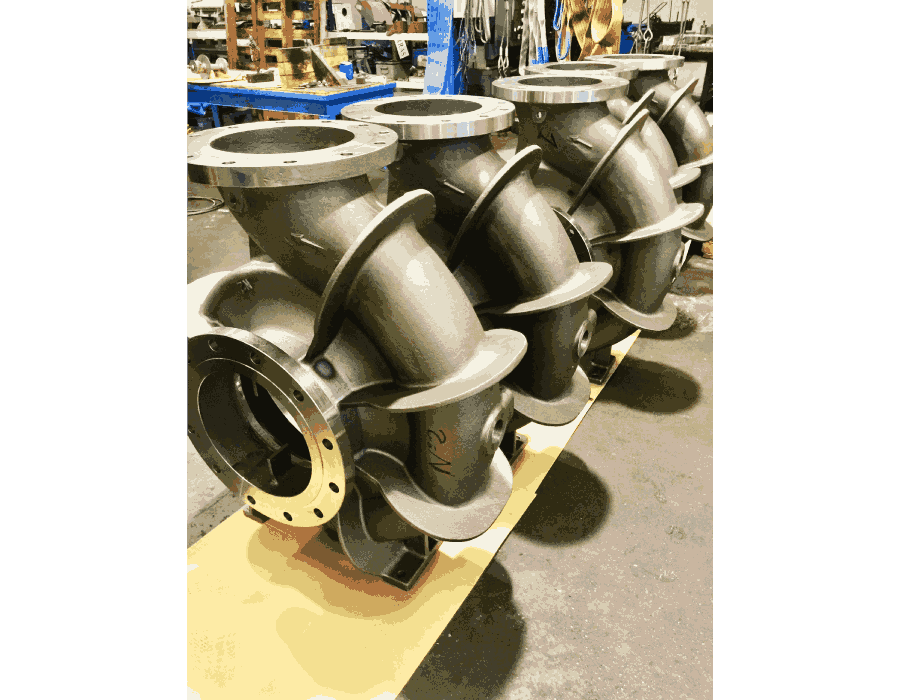
Understanding the main centrifugal pump parts is essential to evaluate how these industrial pumps work, why they are used in demanding applications and which components require special attention during manufacturing, machining, welding and quality control.
Centrifugal pumps are widely used in sectors such as Oil & Gas, petrochemical, naval, pulp and paper, cryogenics, desalination, water treatment and wastewater management. Their performance depends not only on hydraulic design, but also on the precision, material selection and dimensional accuracy of critical components such as the impeller, casing, shaft, covers, sealing areas and bearing housings.
This guide explains the main centrifugal pump components, their functions and the technical requirements that pump manufacturers should consider when working with machined pump parts. If you need a broader introduction to how centrifugal pumps work, you can also read our general guide on centrifugal pumps.
What are the main parts of a centrifugal pump?
The main parts of a centrifugal pump include the impeller, casing, shaft, shaft seal, bearings, motor, base or support structure, inlet and outlet connections, valves, instrumentation and control elements.
Each component has a specific function. Some parts are directly involved in moving the fluid, while others ensure alignment, sealing, support, stability, safety and operational reliability.
From a manufacturing perspective, not all centrifugal pump parts have the same technical requirements. Components such as pump casings, covers, shafts, impellers, sealing areas and bearing housings usually demand tighter control because geometry, concentricity, surface finish and dimensional tolerances can affect pump efficiency, leakage risk, vibration and service life.
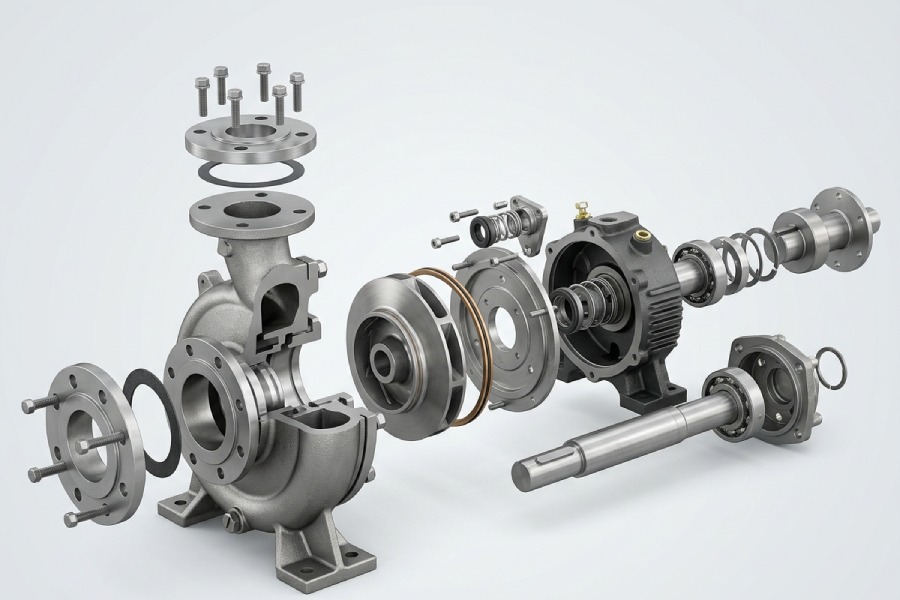
Centrifugal pump parts and their functions
The following table summarizes the main centrifugal pump parts, their function and why they matter from a technical and manufacturing perspective.
| Centrifugal pump part | Main function | Why it matters | Machining relevance |
|---|---|---|---|
| Impeller | Transfers energy to the fluid and increases velocity. | Directly affects hydraulic efficiency and pump performance. | Requires control of geometry, surfaces, balance and functional areas. |
| Casing | Contains the fluid and guides flow from the impeller to the discharge. | Influences pressure, flow path, sealing and overall reliability. | Critical for machined interfaces, flanges, sealing areas and alignment references. |
| Shaft | Transmits rotational energy from the motor to the impeller. | Affects alignment, vibration and mechanical reliability. | Requires concentricity, straightness, surface finish and dimensional control. |
| Shaft seal | Prevents leakage around the shaft. | Essential for safety, cleanliness and process reliability. | Seal housings and contact areas require accurate machining. |
| Bearings | Support the shaft and reduce friction during rotation. | Help prevent excessive vibration, wear and misalignment. | Bearing seats and housings need accurate geometry and alignment. |
| Base or support | Holds the pump and motor in position. | Reduces vibration and supports correct alignment. | Support surfaces and mounting interfaces must be stable and accurate. |
| Valves and instrumentation | Control, monitor and regulate pump operation. | Improve operational safety, flow control and process monitoring. | Connection interfaces and functional areas require dimensional consistency. |
Impeller
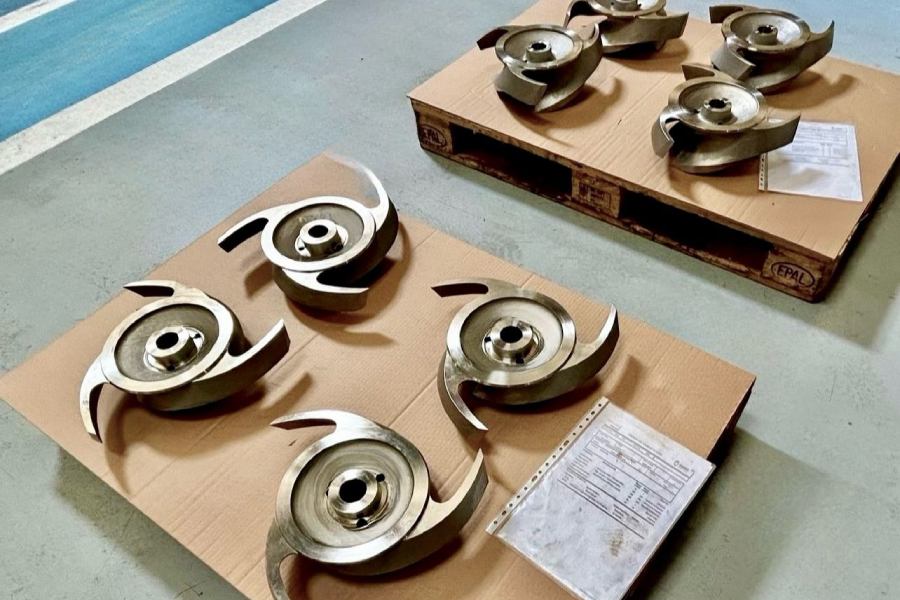
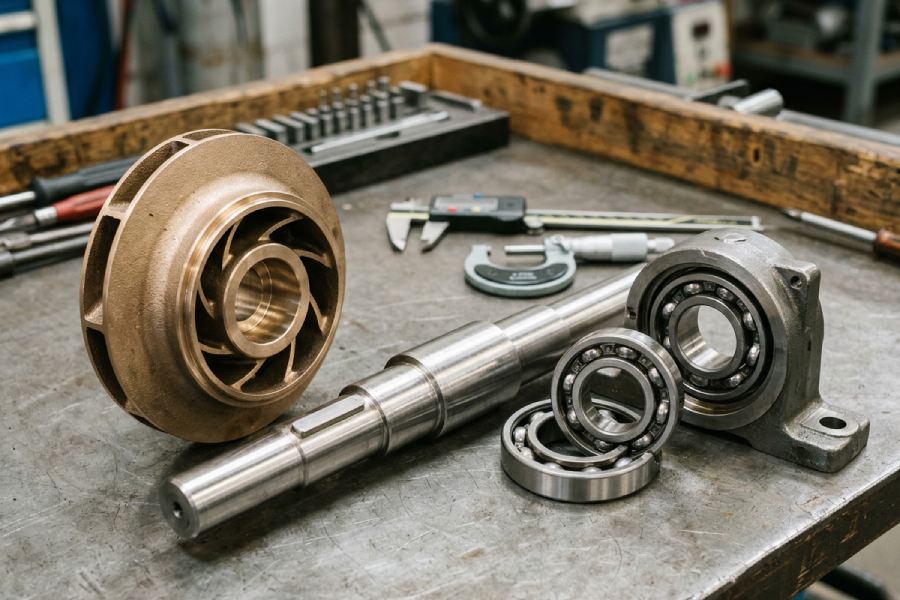
The impeller is one of the most important components of a centrifugal pump. It is located inside the pump casing and connected to the shaft. Its function is to transfer energy from the rotating shaft to the fluid, increasing fluid velocity and generating centrifugal force.
The design of the impeller has a direct impact on pump efficiency, hydraulic performance and operating stability. Its geometry, surface condition and dimensional accuracy are especially important in industrial applications where the pump handles corrosive, abrasive, high-temperature or process-critical fluids.
Types of impellers
The most common types of centrifugal pump impellers are:
- Open impeller: suitable for liquids with suspended solids, often used in wastewater or sludge applications.
- Semi-open impeller: used for more viscous, corrosive or moderately contaminated fluids.
- Closed impeller: commonly used for clean, non-abrasive fluids where efficiency is a priority.
In manufacturing and repair projects, impeller machining can involve functional surfaces, balancing-related areas, connection zones and geometry-sensitive features. For this reason, dimensional accuracy and quality control are essential.
Casing
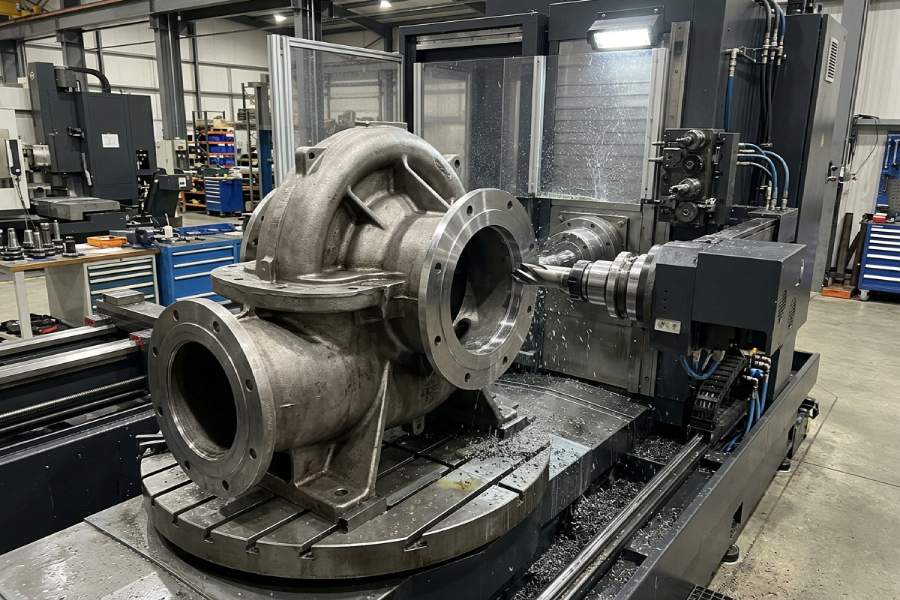
The casing surrounds the impeller and contains the pumped fluid. Its shape guides the liquid as it leaves the impeller and directs it toward the discharge outlet. The casing geometry influences pressure conversion, flow efficiency and hydraulic stability.
There are different casing configurations depending on the application, including volute casings and diffuser casings. The choice depends on the required pressure, flow rate, efficiency and operating conditions.
Types of casings
Common casing configurations include:
- Single-stage casing: used when the application requires a moderate pressure increase.
- Multi-stage casing: used when a higher pressure increase is needed through several impellers and stages.
- Volute casing: designed to collect and guide the flow leaving the impeller.
- Diffuser casing: uses diffuser vanes to improve pressure recovery and efficiency.
From a machining perspective, the casing is one of the most critical centrifugal pump components. Flanges, sealing areas, bearing references, internal surfaces, covers and connection interfaces must be controlled to avoid leakage, misalignment, vibration or assembly problems.
Shaft
The shaft connects the motor to the impeller and transmits rotational energy. It must be robust, accurately machined and correctly aligned to ensure reliable pump operation.
Shaft quality has a direct influence on vibration, bearing life, seal performance and mechanical stability. In demanding sectors such as Oil & Gas, cryogenics, desalination or petrochemical applications, shaft machining must control concentricity, straightness, surface finish and dimensional tolerances.
A poorly machined or misaligned shaft can generate vibration, premature bearing wear, seal failure and reduced pump reliability.
Shaft seal
The shaft seal prevents liquid from leaking from the pump casing to the outside. It is located at the interface between the rotating shaft and the stationary casing.
Depending on the application, centrifugal pumps may use mechanical seals, gland packing or other sealing systems. The choice depends on the fluid, pressure, temperature, environmental requirements and operating conditions.
The accuracy of the seal housing and contact surfaces is critical. Any dimensional deviation in the sealing area can increase leakage risk, reduce seal life or cause premature failure in service.
Bearings
Bearings support the pump shaft and allow it to rotate with controlled friction. They help maintain alignment and reduce mechanical wear during operation.
In centrifugal pumps, bearings perform two main functions:
- Shaft support: they keep the shaft correctly positioned during rotation.
- Friction reduction: they reduce energy losses and help improve mechanical efficiency.
Common bearing types include ball bearings, roller bearings and sleeve bearings. Their selection depends on speed, load, operating conditions and maintenance requirements.
From a manufacturing point of view, bearing housings and seats must be machined with accuracy. Poor alignment or inadequate tolerances can cause vibration, overheating, noise and premature bearing failure.
Motor
The motor provides the power required to operate the centrifugal pump. In most industrial applications, centrifugal pumps are driven by electric motors, although other drive systems may be used depending on the environment and process requirements.
Motor power, speed, coupling and control systems must be properly matched with the pump design to ensure stable operation.
Base or support structure
The base or support structure holds the pump and motor in the correct position. It must be strong enough to support the weight of the equipment and resist vibration, dynamic loads and operational forces.
Correct alignment between pump and motor is essential. For this reason, support surfaces, mounting points and structural stability play an important role in long-term reliability.
Inlet and outlet valves
Inlet and outlet valves control the flow of liquid into and out of the pump. They help regulate operation, isolate equipment, prevent backflow and protect the system from pressure variations.
Although valves are not always considered part of the pump itself, they are essential for safe and efficient pump operation in industrial systems.
Instrumentation and controls
Depending on the application, centrifugal pumps can be equipped with pressure sensors, flow meters, temperature sensors, vibration monitoring devices and automatic control systems.
These elements help monitor performance, detect abnormal operating conditions and improve process reliability in sectors such as petrochemical, Oil & Gas, water treatment and industrial processing.
Materials used in centrifugal pump parts
Material selection depends on the pumped fluid, temperature, pressure, corrosion risk, abrasion, sector requirements and expected service life.
Common materials used in centrifugal pump components include:
- Cast iron: used in general applications with moderate operating conditions.
- Carbon steel: suitable for industrial services requiring mechanical strength.
- Stainless steel: used when corrosion resistance is required.
- Duplex and super duplex stainless steels: suitable for aggressive environments, seawater, desalination or demanding corrosion conditions.
- Special alloys: used in cryogenic, petrochemical, Oil & Gas or highly corrosive applications.
In critical components, material selection must be combined with accurate machining, welding control, dimensional inspection and traceability. This is especially important in pump casings, impellers, shafts, covers and sealing areas.
In aggressive environments, material selection may require stainless steel, duplex or super duplex solutions, especially when components are exposed to corrosion, seawater or demanding process conditions.
Machining requirements for critical centrifugal pump components
Many centrifugal pump components require precision machining because their geometry directly affects performance, assembly and reliability.
Critical machining requirements may include:
- Accurate machining of casing interfaces and flanges.
- Control of sealing surfaces and gasket areas.
- Concentricity and straightness in shafts.
- Dimensional control of bearing housings.
- Precision machining of covers and connection areas.
- Surface finish control in functional areas.
- Stable machining references for large or complex geometries.
For pump manufacturers, working with a technical partner for CNC machining, precision machining, and centrifugal pump machining can help increase production capacity, reduce internal bottlenecks and ensure that critical pump components meet the required tolerances and documentation standards.
Quality control and dimensional inspection
Quality control is essential in centrifugal pump components because small dimensional deviations can affect alignment, sealing, vibration, hydraulic performance and service life.
Dimensional inspection can include checks on:
- Machined interfaces.
- Sealing surfaces.
- Bearing seats.
- Shaft geometry.
- Casing references.
- Flange alignment.
- Critical tolerances defined in the drawing.
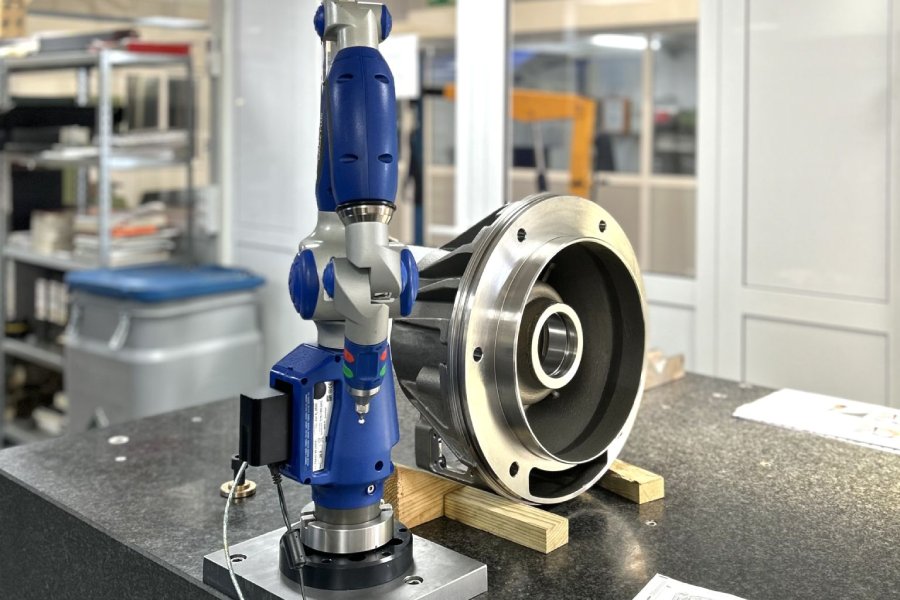
At Asimer Group, dimensional control is supported by technical inspection resources such as metrology room capabilities and measuring arm verification, depending on the requirements of the project.
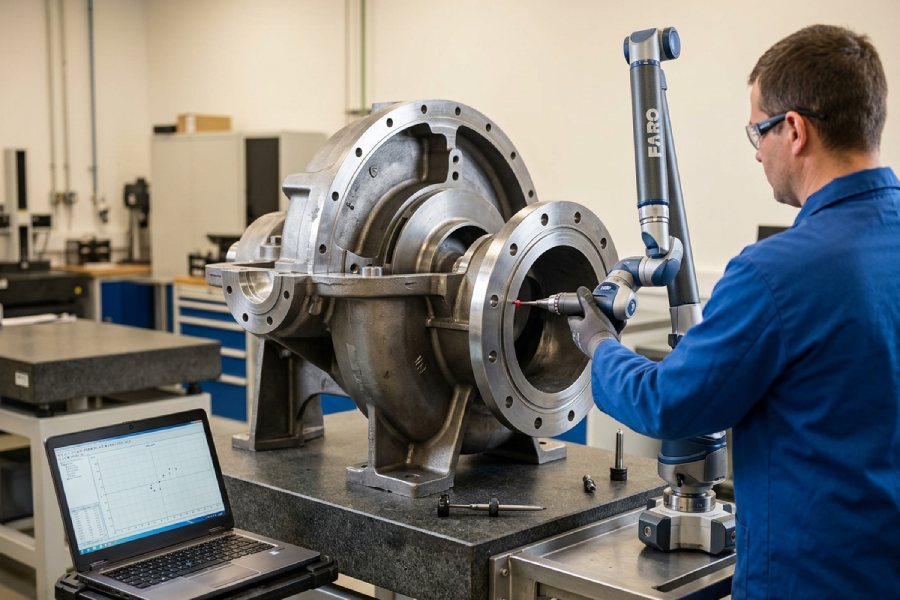
How Asimer Group supports pump manufacturers
Asimer Group supports industrial pump manufacturers with engineering solutions, CNC machining, technical welding and dimensional control for critical pump components manufactured according to customer drawings and specifications.
Our work focuses on adding value to components such as:
- Pump casings.
- Covers.
- Shafts.
- Impellers.
- Sealing areas.
- Bearing housings.
- Components requiring welding, repair or dimensional control.
We do not position ourselves as a standard spare parts supplier. Our role is to act as a technical partner for manufacturers that need machining, welding and inspection support for industrial pump and valve components.
This approach is especially relevant for manufacturers working in demanding sectors such as Oil & Gas, naval, petrochemical, cryogenics, desalination, water treatment and other industrial environments where reliability, traceability and quality control are critical.
Frequently asked questions about centrifugal pump parts
What are the main parts of a centrifugal pump?
The main parts of a centrifugal pump include the impeller, casing, shaft, shaft seal, bearings, motor, base, inlet and outlet connections, valves, instrumentation and control elements.
What is the function of the impeller in a centrifugal pump?
The impeller transfers energy to the liquid and increases its velocity. Its geometry has a direct impact on hydraulic performance, efficiency and pump reliability.
What materials are used in centrifugal pump parts?
Materials depend on the fluid, temperature, corrosion risk and sector. Common options include cast iron, carbon steel, stainless steel, duplex and super duplex stainless steels, and special alloys for demanding environments.
Which centrifugal pump components require precision machining?
Critical machined components include casings, covers, shafts, impellers, sealing areas, bearing housings and connection surfaces where geometry, alignment and tolerances affect performance.
Can Asimer Group machine centrifugal pump components under drawing?
Yes. Asimer Group supports pump manufacturers with CNC machining, technical welding, dimensional control and quality documentation for critical pump components manufactured according to customer drawings and specifications.
Do you need CNC machining support for centrifugal pump components?
Do you need CNC machining support for centrifugal pump components?
Tell us the type of pump component, material, dimensions, tolerances and quality requirements. Our technical team can review your project and evaluate how Asimer Group can support machining, welding and dimensional control.
Contact our technical team