

CNC machining of pump impellers is one of the most sensitive factors in the actual performance of a centrifugal pump: small errors in geometry, surface finish or alignment translate into cavitation, vibration, customer complaints and skyrocketing OPEX. For an industrial pump manufacturer, this is not theory; it is lost margin and reputation at stake.
When you analyse the industrial applications of centrifugal pumps (Oil & Gas, cryogenics, desalination, water treatment, naval, etc.), the impeller is the component that converts mechanical energy into hydraulic energy. If the machining is not controlled to the millimetre, all the prior design engineering is diluted.
CNC machining of pump impellers and its impact on cavitation and OPEX
Among the different parts of a centrifugal pump, the impeller is the source of most cavitation phenomena, noise and efficiency losses. Three typical effects appear when machining is not adequate:
- Loss of hydraulic performance: the pump requires more energy to deliver the same flow rate.
- Premature cavitation: erosion on blades and casings that leads to diagnosed centrifugal pump failures and costly repairs.
- Vibration and mechanical fatigue: these shorten the service life of bearings, shafts and seals.
For purchasing and project teams, the question is not “how much does it cost to machine this impeller?”, but rather “how much will it cost me in claims and downtime if the machining is not perfect?”.
Typical errors in CNC machining of pump impellers
Blade thickness and flow channels out of tolerance
When the supplier treats the impeller as “just another complex part”, you start seeing:
- Blades with variable thickness.
- Poorly defined fillet radii.
- Distorted flow passages.
This generates turbulence and head losses: the pump behaves differently from what was calculated in the design phase and the risk of cavitation increases.
Inadequate surface finish in high-velocity areas
Roughness and surface finish on the pressure and suction sides of the blades are critical. A CNC machining process without proper parameter control and clear finishing criteria:
- Increases hydraulic losses.
- Drives noise and vibration levels up.
- Accelerates erosion caused by cavitation.
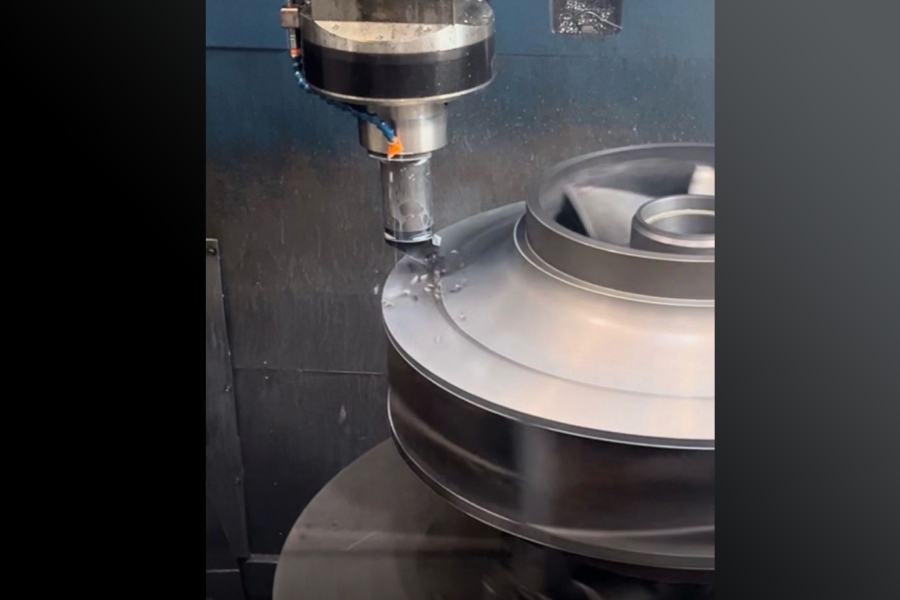
At this point, CNC technology, 4/5-axis milling strategies and the use of CNC machining tools adapted to the material (stainless steel, super duplex, ductile iron, etc.) become essential.
Misalignment between impeller and shaft
The hub bore, keyway and reference surfaces must guarantee concentricity and parallelism. Poor machining or adjustment in these areas results in:
- Misalignment between impeller and shaft.
- Dynamic vibrations that propagate to the rest of the pump.
- Early fatigue in supports.
A robust chip-removal machining process should include, beyond turning and milling, thorough dimensional control of all reference surfaces.
Insufficient verification of radii, edges and critical areas
When the supplier works with partial or non-systematic inspections, many issues go unnoticed until the pump is already in service. An OEM of industrial pumps needs the assurance that each impeller has been measured systematically, not based on improvised sampling.
What is really at stake for a pump manufacturer
Damage caused by cavitation or surface erosion on impellers translates into:
- More warranty claims and rework at the manufacturer’s expense.
- Internal costs related to disassembly, cleaning and replacement of impellers.
- Impact on the relationship with the end customer when the pump fails in the field.
This is why it’s so important to evaluate not only the unit price of the impeller, but also the supplier’s real capabilities in process design, dimensional control and non-destructive testing (NDT) when required.
How a specialist supplier in CNC machining of impellers should work
Shared engineering and definition of critical areas
A good partner does not just receive a drawing and start machining. They work with you to:
- Identify the areas where geometry and surface finish have the greatest influence on cavitation and efficiency.
- Adjust reasonable tolerances according to material and service conditions (corrosive, cryogenic, slurry, seawater, etc.).
- Align design requirements with proven experience in high-precision machining for the oil & gas sector and other demanding environments.
Machines and capacity for large diameters
Impellers in DN600, DN900 or larger require:
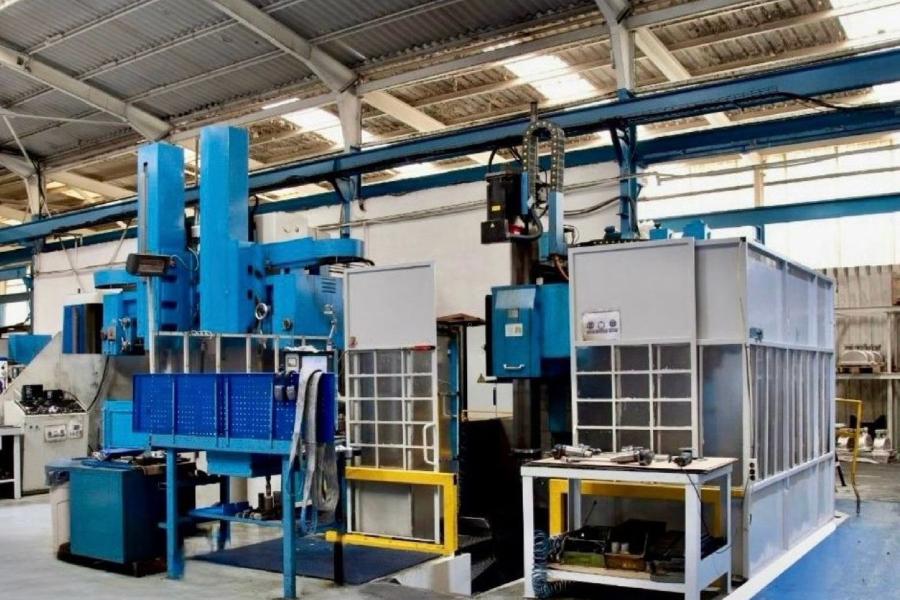
- Large vertical lathes and milling machines.
- Rigid clamping conditions to avoid deformation.
- Machining strategies adapted to complex 3D geometries, similar to those of rotors and turbines.
The right combination of heavy-duty machines and advanced CNC technology makes it possible to maintain tight tolerances even on large diameters.
Metrology room and advanced dimensional control
To guarantee repeatability, the supplier should have a well-climatized metrology room equipped with measuring instruments capable of:
- Measuring 3D geometries of blades and flow channels.
- Verifying concentricity, parallelism and flatness between reference surfaces.
- Issuing dimensional reports (FAI/ISIR) linked to each batch.
Without this level of control, the risk of dimensional dispersion between parts in the same series is high.
Surface quality and complementary tests
In certain applications, especially when impellers work with aggressive fluids or under extreme conditions, it is advisable to complement the process with:
- Quality plans aligned with the non-destructive tests required by the sector (PT, MT, UT, VT).
- Homogeneous acceptance criteria between your quality department and the supplier.
Checklist to compare suppliers of CNC machining for pump impellers
As a buyer or project manager, you can use this checklist in your next RFQs:
- Do they have proven experience in machining impellers within the industrial pump cluster, and can they show similar projects in terms of size and material?
- Do they have machines and specific fixtures for impellers (not only for flat components)?
- Do they have a metrology room and 3D measuring equipment to inspect blades and channels?
- Do they provide complete dimensional reports and traceability by serial number?
- Do they integrate non-destructive testing when the application requires it?
- Do they help you optimise machining costs for pumps and valves by proposing process or design improvements?
- Do they have experience in sectors where failure is not an option (Oil & Gas, cryogenics, desalination), leveraging accumulated know-how in high-precision machining for the oil & gas sector?
If the answer to several of these questions is “no”, that supplier is probably not the strategic partner you need for your impellers.
How Asimer Group helps you reduce risks and costs in your impellers
At Asimer Group we work exactly at the intersection between design, machining and in-service reliability. For an industrial pump manufacturer, this translates into:
- Real experience machining impellers for different industrial applications of centrifugal pumps (Oil & Gas, cryogenics, water treatment, naval, desalination, etc.).
- Capacity to machine large diameters by combining vertical lathes, machining centres and CNC machining tools specifically selected for each case.
- Integration of CNC machining, advanced welding and dimensional control for complete pump assemblies (casing, covers, impeller, shaft), with a global view of all the parts of a centrifugal pump.
- A methodology focused on optimising machining costs for pumps and valves without sacrificing precision: the aim is to reduce total cost of ownership, not just unit part price.
Frequently asked questions about CNC machining of pump impellers
What does CNC machining of pump impellers really offer compared to conventional processes?
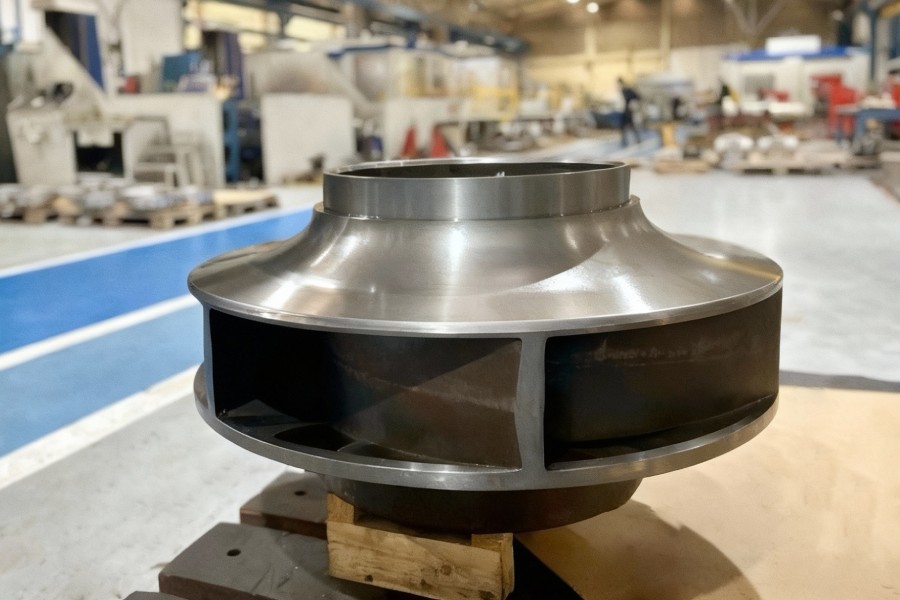
CNC machining of pump impellers makes it possible to maintain tight tolerances and complex geometries in blades and flow channels, something very difficult to achieve with conventional methods. This results in higher hydraulic efficiency, reduced risk of cavitation and better repeatability between parts, especially in large production series.
When is it advisable to combine machining with overlays or surface treatments?
In corrosive applications or when handling abrasive fluids, the impeller may require overlays or special materials. The decision depends on the pumped medium, temperature and working pressure, and must be aligned with the overall pump design strategy and the circuit in which it operates.
What documentation should a supplier of machined impellers provide?
At a minimum, it is advisable to request:
- Signed drawing and control plan.
- Complete dimensional report.
- Records of non-destructive testing if performed.
- Material traceability, especially in stainless steel or super duplex impellers.
How does all this help reduce the end user’s OPEX?
A well-designed and correctly machined impeller reduces unplanned shutdowns, energy consumption and premature replacement of parts. For the OEM, this means fewer claims and a stronger value proposition compared to competitors.
If you want to review your current situation regarding impellers and machining suppliers, we can help you assess risks, costs and potential improvements in the process.Pensando
Do you want to reduce cavitation and failures in your impellers?
Tell us what type of pumps you manufacture and what issues you are seeing in your impellers. We will review with you the current design, the machining process and potential improvements to reduce OPEX, cavitation and claims from your end customers.
Talk to Asimer Group’s team