
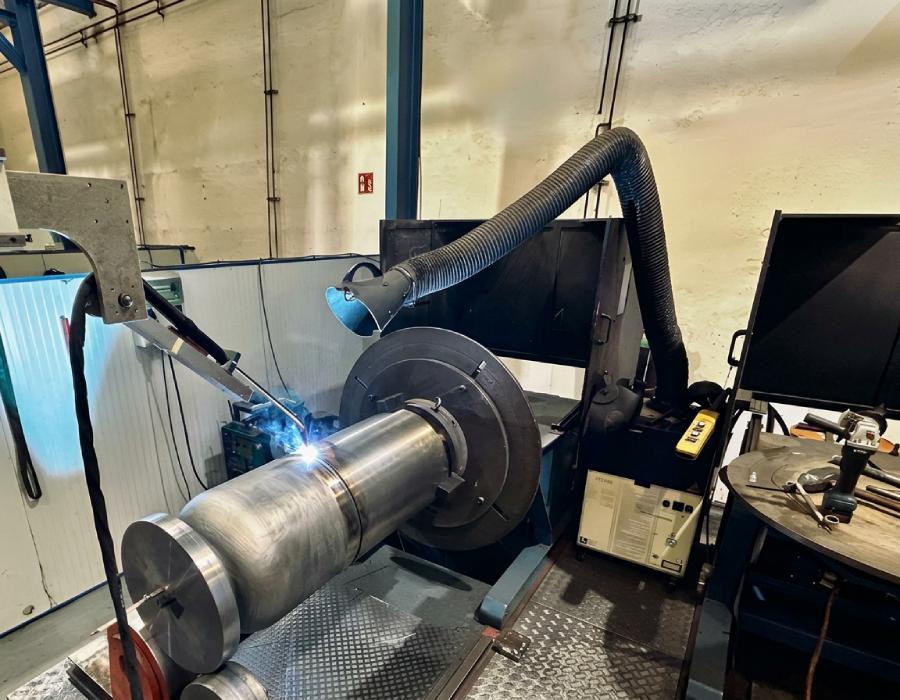
Automating a MIG welding process can improve repeatability, productivity and process control in certain industrial projects. However, not every welding operation is suitable for automation, and not every component can achieve real benefits simply by introducing an automated system.
In many cases, problems appear when the decision is based only on volume, speed or time reduction, without previously assessing the geometry of the part, quality requirements, joint preparation, access to the welding area or integration with machining and inspection.
For this reason, before automating a MIG welding process, a complete technical assessment is required. The goal should not be to automate for the sake of automation, but to determine whether the process can provide stability, repeatability and efficiency without compromising the final quality of the component.
Why automating a MIG welding process requires a prior technical assessment
The automation of MIG welding processes can be an effective solution when the project requires repetitive welds, stable parameters and controlled production. It is especially useful in industrial components where process uniformity has a direct impact on quality, productivity or traceability.
However, automation does not remove technical complexity. On the contrary, it requires a more precise definition of the process conditions: base material, geometry, welding position, edge preparation, accessibility, filler material, travel speed, temperature, inspection and acceptance criteria.
One of the most common mistakes is to consider automated MIG welding as a universal solution. In practice, its application must be assessed case by case. A project may have enough volume, but not a suitable geometry. Or it may offer good accessibility, but require additional controls that affect the process.
Before making a decision, it is therefore important to assess whether automation provides real value to the project and whether the technical conditions allow a stable process throughout production.
Mistake 1: automating without analysing the geometry of the part
The geometry of the component is one of the most important factors when assessing the automation of a MIG welding process. It is not enough to know that a part needs to be welded; it is necessary to analyse how the welding area can be accessed, what shape the component has, how it will be positioned during the process and whether the welding path can be repeated with stability.
In industrial projects, many parts include complex geometries, variable thicknesses, critical areas or surfaces that must later be machined. Automating without reviewing these aspects can cause execution difficulties, lack of weld uniformity or integration problems in later stages of the project.
It is also important to assess whether the part allows proper fixturing and positioning. If the component cannot be positioned in a stable way, or if there are relevant dimensional variations between units, automation may lose part of its advantage.
Before automating, the geometry must therefore be reviewed to confirm whether it allows a controlled welding path and whether the process can be repeated without constant adjustments.
Mistake 2: not defining the MIG welding parameters correctly
Another frequent mistake is to automate the process without properly defining the MIG welding parameters. Automation does not correct poor technical definition by itself. If the parameters are not properly established, the system may repeat the same error consistently.
In an automated process, variables such as current, voltage, travel speed, filler material, shielding gas, distance, work angle and joint preparation must be correctly adjusted from the beginning.
When these parameters are not properly studied, problems such as lack of penetration, excess filler material, distortion, discontinuities, variations in weld bead geometry or inconsistent results in critical areas may appear.
The advantage of automating a MIG welding process lies precisely in repeating stable conditions. But that repeatability is only positive if the initial conditions are technically well defined.
Before moving to an automated solution, it is necessary to validate the process and ensure that the parameters respond to the real requirements of the component.
Mistake 3: ignoring the real repeatability of the project
Repeatability is one of the main reasons to automate a MIG welding process, but it can also become a source of problems if it is interpreted incorrectly.
A project may seem repetitive because it includes several similar units, but that does not necessarily mean that all parts will behave in the same way during the process. There may be variations in casting, previous machining, tolerances, distortion, edge preparation or positioning.
If these variations are not considered, the automated process may require constant adjustments, reducing the expected efficiency and increasing the risk of incidents.
Real repeatability does not depend only on the number of parts. It depends on whether the technical conditions are stable enough to execute the process with consistent criteria.
Before automating, it is advisable to check whether the project allows reliable references, controlled positioning and a coherent welding sequence.
Mistake 4: not assessing access to the welding area
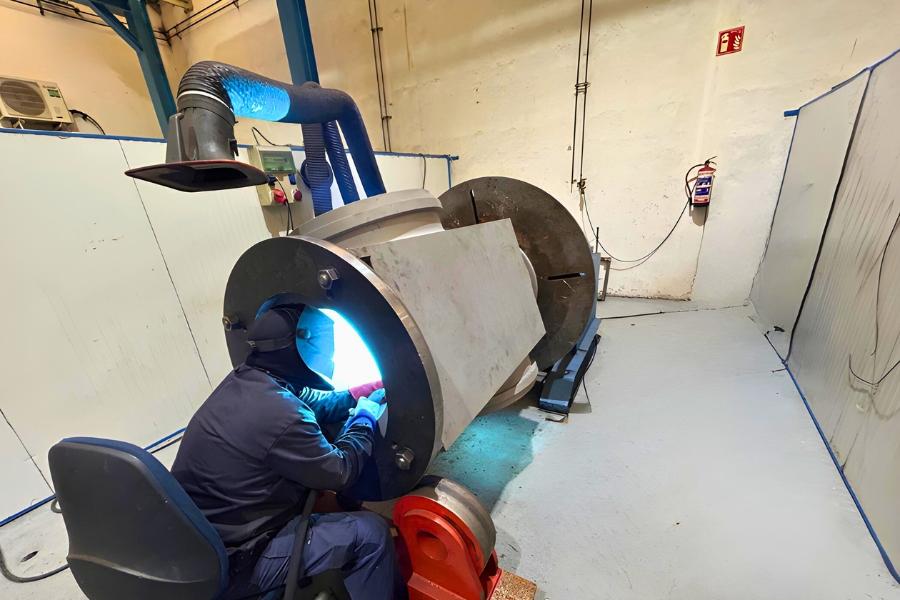
Access to the welding area is another critical factor. In some industrial components, welding must be performed in internal areas, complex angles, curved surfaces or zones close to functional geometries.
If access is not properly analysed, the automated system may not have enough travel range, the work angle may not be suitable or the torch may not be able to maintain a stable position throughout the entire welding path.
This can directly affect weld quality and process continuity.
Access should also not be evaluated only from the welding point of view. It is also necessary to consider whether the area will later require machining, inspection or dimensional verification.
In industrial projects, welding, machining and inspection should not be analysed as isolated stages. The decision to automate must take the entire technical flow of the component into account.
Mistake 5: separating welding from machining and dimensional control
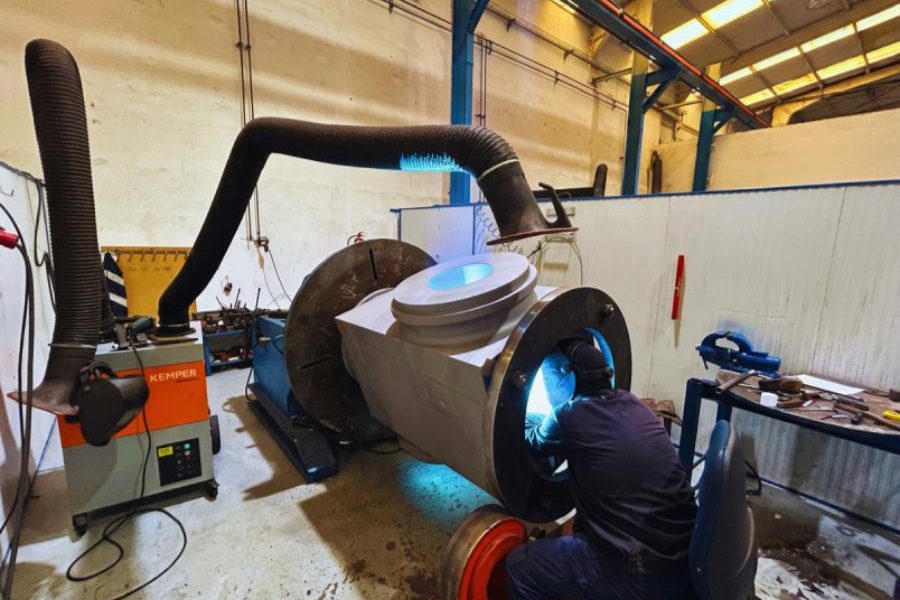
One of the most important mistakes in industrial projects is to treat welding as an independent operation, without connecting it with CNC machining, inspection and dimensional control.
In many critical components, welding can affect areas that must later be machined or verified. It can also generate distortion, stresses or dimensional variations that need to be controlled within the overall process.
For this reason, when a MIG welding process is automated, it is important to assess how that operation fits within the complete manufacturing sequence of the component.
The integration with CNC machining of industrial components makes it possible to anticipate references, machining allowances, functional areas and work sequences. This helps reduce incidents and improve the technical consistency of the project.
At this point, the objective should not be only to weld faster, but to ensure that the final component meets the dimensional, functional and documentation requirements defined by the customer.
Mistake 6: not planning quality control and inspection
Automating a MIG welding process does not eliminate the need for inspection. In fact, in industrial projects, automation must be supported by suitable controls to verify that the process maintains the required quality.
Depending on the type of component, the sector and the customer requirements, visual testing, liquid penetrant testing, dimensional verification, documentation traceability or specific inspections included in the quality plan may be required.
A common mistake is to assume that, because the process is automated, the result will always be correct. Automation improves stability, but it does not replace technical validation or quality control.
Inspection criteria should therefore be defined before the project is executed. This makes it possible to detect potential deviations, document the process and ensure that the solution meets the agreed technical requirements.
What to review before automating a MIG welding process
Before automating a MIG welding process, several technical factors should be reviewed:
- Part geometry.
- Base material and thickness.
- Joint preparation.
- Access to the welding area.
- Component positioning and fixturing.
- Real repeatability between units.
- MIG welding parameters.
- Inspection requirements.
- Integration with CNC machining.
- Traceability and documentation needs.
This review makes it possible to decide whether automation is technically feasible and whether it will provide real advantages to the project.
In some cases, industrial MIG welding may be sufficient. In others, an automated solution can improve productivity, uniformity and process control. The key is to choose the right option according to the component, volume, material and quality requirements.
How Asimer Group supports automated MIG welding projects
At Asimer Group, the automation of welding processes is assessed from a complete industrial perspective. The analysis does not focus only on the execution of the weld bead, but also on the geometry of the part, previous or subsequent machining, inspection requirements, traceability and the final function of the component.
This approach makes it possible to assess whether a project fits an automated MIG welding service and which conditions must be met for the process to be stable, repeatable and technically feasible.
When the project requires it, welding can also be integrated with other industrial capabilities such as CNC machining, inspection, dimensional control or technical documentation.
The objective is to reduce incidents, improve process consistency and provide a solution adapted to industrial components that require control, repeatability and reliability.
Frequently asked questions about mistakes when automating MIG welding processes
When can it be a mistake to automate a MIG welding process?
It can be a mistake when the geometry of the part, access to the welding area, project repeatability or inspection requirements do not allow a stable process. Automation should provide control and efficiency, not add unnecessary complexity to the project.
Does automated MIG welding always improve productivity?
Not always. It can improve productivity when there are repetitive conditions, stable parameters and proper process preparation. If the parts present many variations or require constant adjustments, the improvement may be limited.
Which technical factors should be reviewed before automating?
Before automating, it is advisable to review the geometry of the component, material, thicknesses, joint preparation, torch access, part fixturing, welding parameters, quality controls and integration with machining or inspection.
What problems can appear if MIG welding parameters are not properly defined?
Problems such as lack of penetration, excess filler material, distortion, discontinuities, weld bead variations or inconsistent results between parts may appear. In an automated process, a poorly defined parameter can be repeated consistently.
Why is it important to integrate welding, machining and inspection?
Because in many industrial components, welding can affect areas that later need to be machined, inspected or dimensionally verified. Integrating these stages helps reduce incidents and ensures that the final component meets the technical requirements.
Final criteria before automating a MIG welding process
Automating a MIG welding process can provide significant advantages in industrial projects, but only when the decision is based on a solid technical assessment.
The most common mistakes usually appear when automation is implemented without analysing the geometry of the part, without properly defining the parameters, without checking the real repeatability of the project or without integrating welding with machining, inspection and dimensional control.
Before deciding, it is therefore advisable to carry out a technical assessment of the component and the complete process. Automation should be a tool to improve quality, productivity and stability, not a solution applied automatically to any project.